Introduction: The Dream vs. Reality
Related Guides & Resources
For many office workers, the dream of homeownership feels increasingly like a financial mirage. With rising property prices and the creeping cost of living, the gap between a monthly salary and a 20% down payment can seem insurmountable. However, the secret to crossing this bridge isn’t a sudden windfall or a lottery win; it is the disciplined application of strategic financial planning over a medium-term horizon. This guide lays out a practical plan to save for a house down payment in five years.
Try it: use our free Savings Goal Calculator to see how much to save each month.
In this guide, we will break down the exact mathematical and behavioral roadmap required to go from $0 to a home down payment in exactly 60 months. This is not a “get rich quick” scheme—it is a “get a house for sure” system.
Phase 1: The Foundation (Months 1–6)
1.1 The Brutal Audit: Knowing Your Numbers
You cannot manage what you do not measure. The first three months are dedicated to a forensic audit of your cash flow.
- Fixed vs. Variable Costs: Categorize every cent. Fixed costs (rent, utilities) should ideally not exceed 50% of your take-home pay.
- The “Latte Factor” Reimagined: It’s not just about coffee; it’s about recurring subscriptions, unused gym memberships, and “convenience taxes” (like food delivery apps).
- Action Step: Use tools like Mint or YNAB to track every transaction for 90 days.
1.2 Defining the Target
“A down payment” is too vague. You need a hard number.
- Research the Market: Look at 5-year price trends in your target neighborhood. If a starter home costs $400,000 today, assume a 3% annual appreciation. In five years, that house might cost $463,000.
- The 20% Goal: Aim for 20% to avoid Private Mortgage Insurance (PMI), but research low-down-payment programs (FHA, etc.) as a backup.
Phase 2: Mastering the “Gap” (Months 7–24)
The “Gap” is the difference between what you earn and what you spend. To save a down payment in five years, you must aggressively widen this gap.
2.1 The 50/30/20 Rule – Adjusted for Homeownership
Traditional advice suggests saving 20%. To hit a 5-year goal, you likely need to aim for 30–40% savings rates.
- Housing Arbitrage: Consider “house hacking” early—renting a cheaper room or moving back with parents for 24 months. This is the single fastest way to teleport toward your goal.
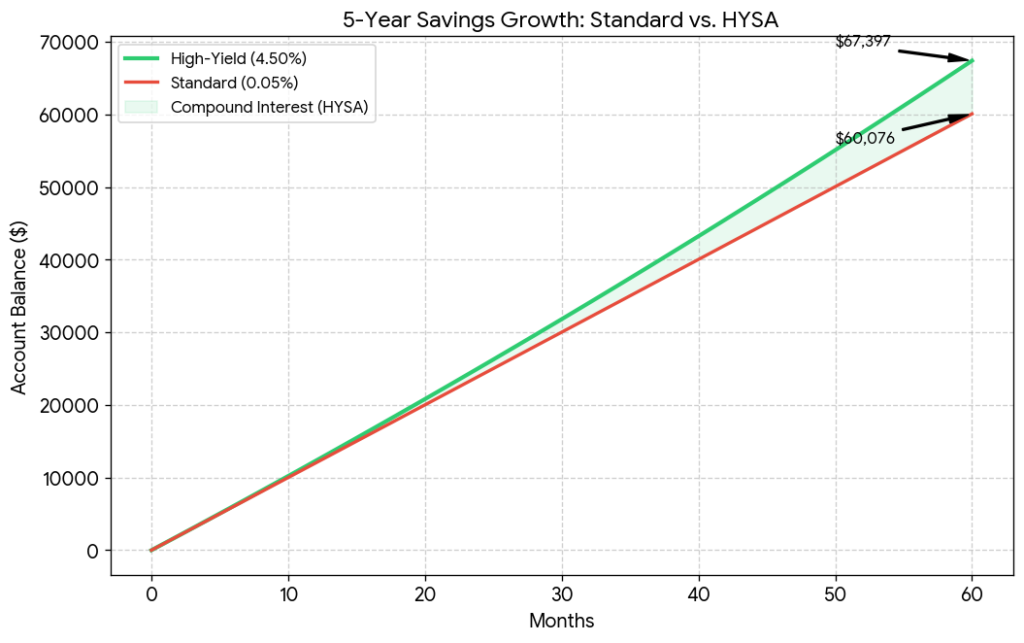
- Automated Scarcity: Set up an automatic transfer to a High-Yield Savings Account (HYSA) the day your paycheck hits. If you don’t see the money, you won’t spend it.
2.2 Psychological Fortitude: Delayed Gratification
The middle years are where most people quit. You will see friends buying new cars or vacationing in Europe. You must view your savings account not as “trapped money,” but as “purchased freedom.”
Phase 3: Defensive Investing (Months 25–48)
With a 5-year timeline, you cannot afford the volatility of a pure stock market play, nor can you accept the 0.01% interest of a traditional big-bank savings account.
3.1 Where to Park Your Cash
- High-Yield Savings Accounts (HYSA): Essential for liquidity and safety.
- Certificates of Deposit (CDs): Lock in rates if you have a lump sum you won’t touch for 12–18 months.
- Short-Term Government Bonds/T-Bills: Offer tax advantages and higher yields than standard savings in high-interest environments.
- The “Safe” Portion of the Market: A conservative allocation (e.g., 20% in an S&P 500 ETF like VOO) might be acceptable in years 1–3, but should be liquidated into cash as you approach year 5.
Phase 4: Offensive Income Scaling (Continuous)
You cannot save your way out of a low income. A typical office salary has a ceiling; your side potential does not.
4.1 Upskilling for the Day Job
The easiest “side hustle” is a 20% raise at your current job. Spend $500 on a certification that makes you worth $10,000 more per year. Apply 100% of every raise directly to the down payment fund (Lifestyle Inflation Avoidance).
4.2 The “Down Payment Side Hustle”
Dedicate one specific stream of income only to the house. Whether it’s freelance writing, consulting, or selling digital products, this money never enters your checking account. It goes straight to the “Path to Home” fund.
Phase 5: The Final Sprint (Months 49–60)
5.1 Cleaning Up the Credit Profile
Your down payment gets you in the door, but your Credit Score determines how much you pay for the door over 30 years.
- Pay down all revolving debt (Credit Cards).
- Do not open new lines of credit or buy a new car in the 12 months leading up to your mortgage application.
5.2 Closing Costs and the “Hidden” 5%
Many first-time buyers save the 20% down payment but forget:
- Closing Costs: (Typically 2–5% of the home price).
- Emergency Maintenance Fund: Never move into a house with a $0 bank balance. You need at least 3–6 months of expenses for the “Day 1” furnace failure.
Conclusion: Your Path to Homeownership
Building a down payment in five years is a marathon of 1,825 days. It requires a shift from a “consumer mindset” to an “owner mindset.” By following this blueprint—auditing your life, automating your savings, and protecting your capital—the keys to your new home are not just a possibility; they are an inevitability.
Start today by calculating your “Gap.” What is one expense you can cut tonight to move one square inch closer to your front door?
Related Reading
- The 50/30/20 Budget Rule: A Simple Way to Manage Your Money
- How to Build an Emergency Fund: A Step-by-Step Guide for Beginners
- A Complete Guide to SGOV and BIL: Managing Dollar Liquidity with Ultra-Short US Treasury ETFs
Important Disclaimer
The information in this article is for general educational purposes only and does not constitute financial, investment, tax, or legal advice. All investing involves risk, including the possible loss of principal. Examples are simplified illustrations, not predictions. Consider consulting a qualified professional before making financial decisions. See our full Disclaimer.
Pingback: How Credit Scores Work: FICO Ranges, Factors, and How to Improve - WealthPath Guides